The Endeavour programme
ISIS is committed to staying at the forefront of global research by continuously upgrading its world-class neutron and muon instruments. The Endeavour Programme is a bold step forward, introducing four cutting-edge instruments and five major upgrades over the next decade, ensuring that ISIS remains a global leader in neutron science.
Endeavour will drive advancements in three crucial areas: materials of the future, clean growth, and life sciences—directly supporting key government goals like Net Zero, the circular economy, hydrogen energy, and healthcare.
With its unique capabilities, Endeavour will revolutionise the development of materials for energy storage, carbon capture, advanced reactors, renewable energy, drug delivery, vaccine production, and chemical industry catalysts. This programme represents a transformative investment in science and society, positioning the UK at the forefront of global innovation.
Phase 1 instruments
HRPD-X
HRPD-X will provide high-resolution diffraction, setting a new global standard.
Why do we need HRPD-X?
To expand the current instrument’s user base into new research areas and maintaining its position as a world-leading facility for high resolution powder diffraction using neutrons. HRPD-X will provide detailed information on clean growth materials such as MOFs and zeolites in line with the delivery of Net Zero, the green industrial revolution and the UK’s hydrogen strategy. HRPD-X has applications in gas separation, encapsulation and purification, for example for greenhouse management or the hydrogen economy.
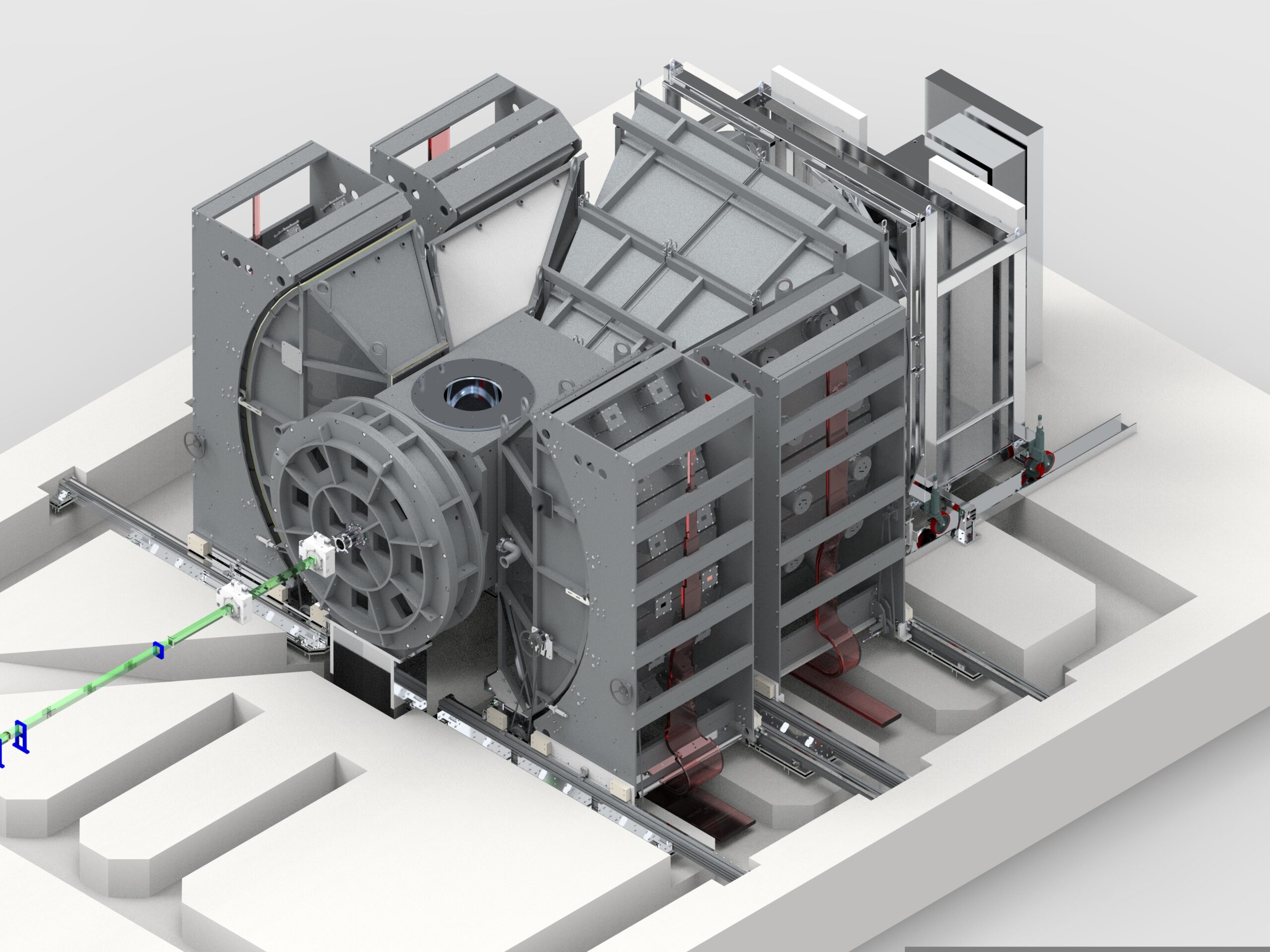
A design drawing of HRPD-X
What is the overall aim of the upgrade?
Retain very high resolution and increase detector coverage so measurements are faster and can measure currently inaccessible materials.
What are the unique capabilities or reasons behind the upgrade?
HRPD is already unique due to it’s very high resolution, but the higher detector coverage will make it the best of its kind in the world.
How does the research enabled by the new instrument contribute to sustainability goals?
High resolution and extended detector coverage would enable measurement of, for example, metal organic frameworks used for carbon capture.
How will sustainability be considered in the design and construction of the instrument?
The construction of new building is designed to save energy and limit climate impact through:
– Heat pumps for temperature control in meeting rooms
– Air conditioning at highest possible temperature that still allows electronics to function
– Reclad tunnel connecting HRPD to the target station for better temperature control and insulation
Technical Success Criteria
• Increase count rates by factor 6 with minimal effect on Δd/d resolution for the backscattering bank.
• Enhance detector coverage to provide access to a wider d-spacing range up to 44Å (compared with 17Å at present), and to ensure that gaps in coverage that emerge when using longer time-of-flight windows are eliminated.
• Retain existing nominal beam size – 40 mm high x 20 mm wide.
• Retain existing incident wavelength range – 0.5 – 11 Å.
• Detector pitch matched with smallest sample dimensions (3 mm)
• Achieve a comparable or higher Δd/d resolution in each detector bank despite large increases in 2θ coverage.
After almost 40 years of operation, HRPD retains its position as one of the leading high-resolution neutron powder diffraction instruments in the world. However, the scientific scope of modern crystallography and materials science in general has evolved over HRPD’s lifetime; furthermore, both hardware and software capabilities have grown. In order to remain at the forefront of neutron scattering science in the coming decades, we plan a complete upgrade of both the instrument and its infrastructure.
The HRPD-X upgrade will include provision of a new non-magnetic sample tank, a new complement of detectors (based on wavelength-shifting fibres), and a new building to house the larger and more capable instrument.
We expect HRPD-X to be ready for commissioning in late-2027 with academic users being welcomed back in 2028.
Key features of the upgrade:
Substantial increase in the solid-angle coverage of the instrument’s detector banks with no loss in resolution for time-focussed data:
- x 4.3 in backscattering, relative to the current instrument;
- x 2.5 at 90-degrees 2θ;
- x 90 in forward scattering.
- Increased coverage at low 2θ will expand the maximum d-spacing in the longest time-of-flight window from ~ 16 to ~ 45 Å.
- Substantial increase in detector sensitivity from adoption of wavelength-shifting fibres (from ~ 20 % (at λ = 2 Å) with the current scintillator modules to ~ 65 % with wavelength-shifting fibres).
- Substantial reduction in instrumental backgrounds from adoption of a radial collimator.
- Potential improvements in resolution from adoption of additional incident-beam conditioning devices.
- Ability to carry out experiments in an applied magnetic field by adoption of a non-magnetic sample tank.
Taken together, these enhancements will enable HRPD to extend its world-leading capabilities to include ever small and more complex samples, exhibiting more subtle behaviours and variations in properties, as well as samples contained in more complex environments, including high-pressure devices and magnets.
As a result we expect HRPD-X to remain at the forefront of crystallography based on high-resolution neutron powder diffraction for decades to come.
Upgrade workshop in 2026
A workshop to update the user community on the progress of the upgrade and to highlight both past achievements and future opportunities will be held in 2026 (venue TBD). If you wish to be notified about any updates in relation to this workshop, or to participate through delivery of an oral or poster presentation then please contact Dr Dominic Fortes and Dr Christopher Howard.
Super MuSR
The next generation of muon spectroscopy instrument with a transformational increase in counting rate and time resolution.
Super MuSR will deliver enhanced capacity and capability relevant to a wide range of studies including Faraday Battery Challenge projects to one of the most oversubscribed ISIS instruments.
Why do we need Super MuSR?
The upgrade will extend the capabilities to a far wider range of complex materials including liquid crystal dynamics, the antioxidant capacity of vitamins, and developing fundamental understanding of reaction kinetics. Super MuSR will support key government priorities in Net Zero, Clean growth, life sciences and quantum technologies.

The Super MuSR beamline layout, showing the two spin rotators, the pulse slicer, focussing quadrupoles, and new spectrometer.
What are the unique capabilities or reasons behind the upgrade?
Super MuSR provides the next generation of muon spectroscopy, enabling new studies with enhanced performance giving access to future functional materials and in-situ battery research with industrial partners such as Toyota.
Technical success criteria
• Count rate improvement of a factor of 20 through improved detector array with current time resolution maintained
• Time resolution increase of factor of 6-10 whilst maintaining present count rate
• Higher transverse fields available through installation of spin rotators in the beamline (giving combined spin rotation of around 70o).
Project summary
Super MuSR is an upgrade of the MuSR instrument to increase its counting rate and time resolution by over an order of magnitude. The current instrument has 64 detectors and follows a simple beamline consisting of slits, steering magnets, and two focussing quadrupoles. The planned instrument will have over 600 detectors with two spin rotators and a pulse slicer added to the beamline. The anticipated performance improvement is shown in the figure below with the science areas that will benefit from the improved capabilities.
Project goals
The current MuSR instrument programme focusses on superconductivity and magnetism, using the muon’s excellent sensitivity to weak magnetic fields to obtain many significant results. The principal limits on possible experiments are the time resolution, limiting the maximum fields that can be measured, and the counting rate, limiting the statistical quality of the data. Super MuSR overcomes both of these limitations.
The increased time resolution increases the magnetic fields that can be applied to superconducting samples and measured inside magnetic samples. For superconductors this provides another way to investigate pairing symmetries and many new ordered magnetic materials will be possible to study at ISIS, particularly transition metal oxides and intermetallic systems.
The increased counting rate will increase the sensitivity to weak magnetic effects like time-reversal symmetry breaking in exotic superconductors and the magnetism of molecular systems, as well as opening up studies of quantum coherence in muon-fluorine bound states and in-operando measurements of battery materials.
Technical details
Current the time resolution of the muon instruments at ISIS is limited by the time width of the pulse of muons reaching the instrument. To improve the time resolution the Super MuSR beamline will include a pulse slicer, which removes the ends of each muon pulse so that the range of muon arrival times is reduced by a factor of up to ten. This is done by applying a large electric field perpendicular to the beam, stopping muons reaching the instrument, then quickly switching to the opposite large electric field. As the field changes through zero a short pulse of muons is able to reach the instrument. Similar technologies are already used in the muon beamline to distribute the beam pulses between multiple instruments and in the main ISIS accelerator.
Many muon measurements are carried out in magnetic fields perpendicular to the spin direction of the muons so that they will precess in the applied field. The primary muon beamline at ISIS provides muons with their spins anti-parallel to their momentum so these transverse field measurements are currently done using fields perpendicular to the beamline. To use the increased field range provided by the pulse slicer it is instead necessary to use spin rotators to rotate the muon spins in flight as they approach the instrument, keeping the measurement field along the beam axis. This avoids the muons being deflected away from the sample by a field perpendicular to their momentum.
To increase the counting rate the Super MuSR detector array will be far more highly segmented than the current MuSR detectors and will cover a larger solid angle around the sample position. New data acquisition electronics will also allow a higher counting rate for each segment. This combination will increase the data collection rate twenty-fold for large samples and collect more than twice as much information per implanted muon, which will improve the performance on smaller samples.
Other improvements include the ‘flypast’ mode of operation already available on the other ISIS muon instruments for measurements of small samples, where muons that don’t stop in the sample are able to fly past it and out of the instrument without generating counts in the detectors. This will benefit significantly from the smaller beam spot available on the MuSR arm of the primary muon beamline.
The Super MuSR beamline layout is illustrated in the picture above, showing the two spin rotators, the pulse slicer, focussing quadrupoles, and new spectrometer.
Phase 2 instruments
Wish-II
Wish-II will be a new cold-neutron, versatile, single crystal diffractometer combined with enhanced polarisation analysis capabilities for Wish that will address challenges in clean growth (such as MOFs) and transformative technologies.
Wish-II will be optimized for the study of single crystals and thin films whilst also allowing experiments on powdered samples. The scientific outputs of the beamline will provide unique understanding of complex materials that are essential to quantum technologies, hydrogen storage and sustainable growth. Combined with an upgrade to the existing Wish beamline to implement polarized neutron measurement capability, the instruments together promise transformative breakthroughs in Advanced Manufacturing, Materials of the Future and Clean Growth.
Mushroom
An entirely novel concept that will be transformative for inelastic neutron scattering. Mushroom will enable use of much smaller samples, more detailed parametric studies, and new types of sample environment and in-situ equipment, in areas such as thin magnetic films, thermo-electrics, magneto-resistive materials, ionic conductors and battery materials.
SANDALS-2
A diffractometer for chemical engineering in amorphous and liquid samples providing information on multi-component samples used in catalysis, drug release, hydrogen storage, oil industry systems and polymers.
Osiris+
A high-resolution spectrometer and diffractometer for studies of atomic and molecular-level motions. This upgrade will enable studies in catalysis and energy materials, enhancing exiting industrial work.
Tosca+
An order of magnitude more flux through development of the Tosca secondary spectrometer for vibrational spectroscopy studies in catalysis and energy materials, enabling the instrument to remain globally competitive.