

Skip to content

Students

ISIS has an annual call for facility development and utilisation studentships. Over recent years, ISIS has funded around 80 of these studentships across a wide range of topics and university partners. Studentships are co-funded - normally 50% funded by ISIS and 50% by a university.

People drinking coffee and talking, with the ISIS target station in the background

Your studentship can be within any of the science areas studied by neutron scattering or muon spectroscopy at ISIS. Studentships should have a strong science case, but they must be focused on benefits to the ISIS facility.

These could include facility infrastructure development (including software), staff development or to further realise the benefits of a project previously funded by this call. 

The annual studentship call

Studentships have an ISIS supervisor and a university supervisor who work in partnership throughout the student's project. Each year we put out a call for academics to be a joint supervisor on one of these studentships, with a deadline for applications usually in September for students to start the following year.

Important Dates for the 2025 studentship call

  Date
Call for Studentships Opens 1 May 2025
  Closes 4pm on 5 September 2025
ISIS Panel Meeting November 2025
Announcement of Results November 2025

What are ISIS Facility Development Studentships?

ISIS wishes to co-fund PhD studentship projects that benefit ISIS. Studentship projects can be within any of the science areas studied by neutron scattering or muon spectroscopy at ISIS and should have a strong science case, but they must be focused on benefits to the ISIS facility. These benefits may include facility infrastructure development (including software), staff development or to further realise the benefits of a project previously funded by this call.

Projects should provide evidence of how the ISIS facility will benefit beyond the lifetime of the project, including evidence of the wider applicability of the project within the community beyond the immediate PhD student project. Letters of support, and direct or in-kind contributions from the science and/or industrial community demonstrating the wider applicability and impact of projects are encouraged. It is recommended that you contact Martin Jones (isis-studentships@stfc.ac.uk) ahead of submitting a proposal to discuss the nature of your facility benefit. Proposal reviewers will wish to know that the project can reasonably be carried out within the duration of a studentship, and that other resources required for the project (e.g. any significant capital or resource costs required) are available from other sources. 

Joint ISIS-Diamond studentships

Diamond is not running a studentship call in 2025, consequently there will be no joint ISIS-Diamond studentships available in this call. 

How many studentships are available?

ISIS will make available funding for approximately six half studentships. 

Eligibility Criteria

ISIS Facility Development Studentships are co-supervised by a UK university or ISIS partner country academic, together with an ISIS staff member. Any academic belonging to a UK university or ISIS partner with the authorisation to supervise PhD students may apply as the university supervisor. An ISIS staff scientist must be a co-applicant and co-supervisor, and play a full and equal role in the studentship project and supervision, including the interviewing of potential candidates. Any applicants who have received previous awards must ensure that a one page closing report on any previous studentships has been submitted to ISIS (isis-studentships@stfc.ac.uk) before applying for a new award.

The student must spend at least one year of their time at ISIS (at RAL for joint ISIS-Diamond studentships), in addition to normal short trips for experiments, during their PhD (in a schedule to be arranged by mutual agreement between the ISIS and university supervisors). Standard PhD progression qualifiers (1st / 2nd year reports etc.) may be used to assess the degree of interaction with the ISIS facility. If it is deemed insufficient interaction has occurred, STFC reserves the right to withdraw funding.

Students will be asked to present their work at ISIS student meetings during their projects. A final report on the outcomes of the project and its impact, together with a student leaving report, will be required at the end of the project. 

What will ISIS provide?

ISIS will provide a fixed amount per year according to the following table which equates to approximately 50% of the cost of a studentship. This assumes that students start in Autumn 2026 with a 4-year studentship.

2026 2027 2028 2029
Paid to the university directly ​ ​ ​ ​
Stipend (Not London) £10,910 £11,455 £12,028 £12,629
Stipend (London) £11,960 £12,557 £13,185 £13,844
Fee £2,628 £2,760 £2,898 £3,043
TOTAL (Not London) £13,538 £14,215 £14,926 £15,672
TOTAL (London) £14,588 £15,317 £16,093 £16,887
Paid with receipts to the student ​ ​ ​ ​
T&S £2000 £2000 £2000 £2000
Harwell Weighting (UK Students only)
£3000​
Harwell Weighting (Partner International Students only) £3000 £3000 £3000 £3000


These amounts are based on UKRI’s studentship stipend from 2025. International partners are Italy and Sweden. Harwell weighting for international students replaces standard Harwell Weighting payments and is not in addition. It may only be paid directly to the students on presentation of receipts.

Matching funds from other sources must be secured by the applicant. The student will need to be registered at the host university, and ISIS will make payments to the university to cover the ISIS portion of the stipend and fees on receipt of invoices from the university. ISIS (STFC/UKRI) will set up an agreement with the host university which specifies a schedule for the invoices and payments to the university to cover the ISIS contribution to the studentship, together with other details of the working arrangements for the studentship.

Up to £2000 per year per student for travel and consumables will also be available for research training expenses including the cost of travelling to and from the Rutherford Laboratory. These funds are to be claimed against actual receipted expenditure provided by the student and will not be paid directly to the University.

ISIS will provide additional funds for ISIS Facility Development PhD students to help cover their costs while they are located at the Rutherford Laboratory. PhD students may claim up to £3000 over the course of their PhD (Harwell Weighting) either for a single extended visit or split up as is appropriate. This money is payable for any additional costs incurred during extended times at ISIS (short visits for experiments are covered by normal ISIS travel & subsistence reimbursement for UK or partner-country users). The ISIS supervisor must provide a letter of support for the claim, which must be submitted to the user office – with evidence of the increased costs – using a standard non-staff expense form. Funds will only be paid directly to the student, and not the host university, and a maximum of £3000 can be claimed over the full duration of the PhD. For international students from partner countries (Italy and Sweden) this payment will be up to £3,000 per annum rather than a single payment of £3,000.

How long are the studentships for?

Studentships can start at any time after the award but should be filled within 1 year of the award and can be for a maximum of 4 years. 

How to apply?

The completed application form, together with a 2-page project description of the science project and the facility development component, and an additional 1-page description of the PhD program, training, risk management and outline time plan for the project. These documents, together with any letters of support, should be emailed to Martin Jones (isis-studentships@stfc.ac.uk) by 4pm on 5 September 2025. Project description must fit within the 2+1 page limit (not counting supporting letters) and must contain the following headings: 

Within 2 pages:

  • Background Background information of the proposal including why it is timely and interesting, and the goals of the project.
  • PhD Project The scientific project to be undertaken by the PhD student should be described.
  • Benefit to ISIS/Utilisation How the project will either benefit the facility or profitably utilise facility development previously funded under this call and must include details of wider use beyond the immediate research team.

Within 1 further page:

  • Description of the training and support that the student will receive
  • Any major project risks and how they will be mitigated
  • Outline time plan for the PhD project (e.g. a simple GANTT chart)

Letters of Support Letters of support from researchers and/or industries within the field should be included. Demonstration of a wide potential user base and significant interest in the proposed development are essential.

Previous Project Outcomes Proposals from applicants who have previously received an ISIS Facility Development Studentship must include a further additional page in their proposal submission listing the outcomes from the previous award. This must include the status of the facility development component of the project and its usage; it should also include the current status of the science project and any publications, presentations, and further grant applications arising from the original award. 

The deadline for applications for this call is 4pm on 5 September 2025.

Assessment process and criteria for studentship proposals

The criteria for assessment are listed below and guidelines for marking issued to referees and panel members are given at the end of this document. 

The quality of the science (50%). External referees chosen from the ISIS facility studentship referees panel will carry out assessment of this criterion (/50). Exceptional proposals will be expected to show world-leading / ground-breaking research with high potential impact academically and/or industrially, likely to result in publication in very high impact general journals and/or top-rated journals for individual fields, or be of strong industrial significance.​ 

The quality of the benefit to ISIS and the ISIS community (25%). Appropriate development projects will be of wider use to the ISIS community beyond the immediate PhD project and may focus on any aspect of ISIS including software, infrastructure and staff development (/25). Unfeasible projects, or those of unclear or poorly defined benefit to ISIS will be rejected. Letters of support from institutions other than that of the applicant(s) demonstrating the significance of the project to the wider ISIS community are encouraged and should be included in the application. The appropriate ISIS group leader will assess facility benefit. Continuation proposals must identify how the facility will benefit from new proposal, including any future development and a previous project outcomes report as described earlier. 

The quality of the PhD training (25%). What will the student undertake during their PhD and how will the combination of ISIS and University resources provide a rewarding and beneficial experience for the student (/25). The proposal must contain a description of the PhD timeline, risk management and training with appropriate milestones highlighted. Members of the ISIS facility studentship panel will carry out assessment of this criterion. 

Submissions from applicants who have had a previous facility development studentship must include a further additional page in their proposal submission listing the outcomes from the previous award.. This will be taken into account when evaluating the new proposal.

Selection process for ISIS Facility Development Students

​​Proposals will be sent for external review and to the relevant ISIS group leaders. Once scores from reviewers and group leaders have been received, a selection panel consisting of ISIS staff and members of the ISIS user community will score the PhD program, assess the referee and group leader scores and comments, and then rank the proposals for potential funding. In addition to the above selection criteria, ISIS will seek a breadth of science areas and partnering universities when making a final decision on which applications will be supported, and will also be concerned regarding diversity of successful applicants. Scoring guidelines for referees, ISIS group leaders and panel members are given in the appendix to this document.

The panel will meet to review proposals soon after the application deadline, and applicants will be informed by the end of November 2025, after which a list of funded project titles and PIs will be published. 

Proposal information:

Applicants should provide the information requested on the application form. The description of the research project should take into account the selection criteria given above and should be a maximum of 2+1 pages (3+1 pages for continuation proposals).

Certain information (applicant and institution, general project description) may be made public by ISIS for successful proposals.​

List of studentships awarded


2024 call 

University  University Supervisor  ISIS Supervisor  Partnership  Project title 
UCL  Foglia  Seel  Basque Centre for Materials  Smart Aza-Macrocycles: Designing Next-Generation Membranes for a Sustainable Future 
Durham  Lancaster  Baker    Probing dynamics with implanted muons: a new paradigm 
Nottingham  Barney  Alderman    Development of high-temperature molten materials research at ISIS 
Manchester  Campbell  Skoda    Tuneable 3D Structures in Biocompatible Polypeptide/Surfactant Films: From Langmuir Troughs to Biomedical Applicatio 
QUB  Swadzba-Kwasny  Youngs    Development of synthetic pathways to isotopically substituted
compounds, removing the key bottleneck in the studies of disordered
materials 
Edinburgh  Attfield  Manuel    Neutron diffraction studies of inorganic microcrystals 
Cambridge  Collins  Kelleher    Synchronised elastic-crystallographic characterisation: Resonating gas
turbine alloys 
Oxford  Blundell  Wilkinson  Oxford / Bristol / Cambridge Superconductivity CDT  Enhancing zero field for muon experiments in superconductors for time-
reversal symmetry breaking  
Oxford  Green  Scherillo  Oxford-ISIS archaeometry agreement  Investigating Early Electrum Coinage with Neutrons and Muons 


Oxford  Aldridge  Mahmoudi  Inorganic Materials for Advanced Manufacturing (IMAT CDT)  Integrating metal-sensitisation into photosurfactant assemblies for light addressable soft matter applications 


Bristol  Hayden  Wood  Oxford / Bristol / Cambridge Superconductivity CDT  Spin Excitations in High Temperature Superconductors- Extracting More from the Data 


2023 call 

University  University Supervisor  ISIS Supervisor  Partnership  Project title 
Birmingham  Lucy Clark  Ross Stewart    Rapid synthesis of high-quality-high-volume quantum materials and the development of magnetic neutron polarisation analysis capability on LET 
Aberdeen  Abbie Mclaughlin  Chris Ridley    In-situ AC/DC Resistivity Measurements and Neutron Powder Diffraction Under Pressure: tuning ionic conductivity by applying external and chemical pressure.  
Birmingham  Clifford Hicks, Matthew Coak  Pascal Manuel    Development of the uniaxial stress environment for neutron scattering, with application to Sr2RuO4 and MnBi2Te4 
Leeds  Lorna Dougan  Hima Kolli, Tom Headen    Molecular resolution of biomolecular assembly by combining SANS, total scattering and course-grained simulation 
Edinburgh  Chris Stock  Russell Ewings    Excitonic magnetism in third-row transition metal ion candidate Kitaev materials 
Manchester  Marta Falkowska  Terri-Louise Hughes    Absorption of gases in nano-confined liquids studied by total neutron scattering 
UCL  Frank Kruger  Goran Nilsen    Signatures of Fractionalisation and Entanglement in the Magnetic Excitation Spectra of Quantum Spin Liquids 
Chalmers (Sweden)  Maths Karlsson  Franz Demmel    Organic cation dynamics and its relationship to luminescence in novel 2D hybrid metal halide perovskites for white lighting 


2022 call 

University  University Supervisor  ISIS Supervisor  Partnership  Project title 
Sheffield  Serena Cussen  Peter Baker    Laying deep foundations for operando muon spectroscopy experiments of ionic diffusion at ISIS 
Manchester  Simon Hunt  Dominic Fortes    Combined Simultaneous Resonant Ultrasound Spectroscopy and Neutron Diffraction Measurements 
Nottingham Trent  Lucas Goehring, Haida Liang  Antonella Scherillo, Najet Mahmoudi    Art, soft matter and SANS: combining optical coherence tomography and scattering methods for art conservation applications 
QMUL  Anthony Phillips  Helen Walker    Neutron scattering from disordered materials: linking experiment to simulation 
Warwick  Mark Senn  Nick Funnell    Understanding pressure-induced softening via high-pressure PDF 
Sheffield  Lewis Owen  Helen Playford    In-situ tensile/compression total scattering measurements 
Trento, Italy  Paolo Rech  Chris Frost    Analysing and Improving the Reliability of Artificial Neural Networks Accelerators 
Manchester  Sihai Yang, Martin Shroeder  Pascal Manuel    Online Structural Investigations of Advanced Porous Materials for A Net Zero Future 
Sheffield  Steven Armes; Oleksandr Mykhaylyk  Peixun Li, Yao Chen  Diamond   
Leeds  Christopher Marrows  Sean Langridge  Diamond   


2021 call 

University  University Supervisor  ISIS Supervisor  Partnership  Project title 
UCL  Bart Hoogenboom  Luke Clifton    Phase behaviour and disruption in model bacterial cell envelopes 
Cambridge  Rachel Evans  Greg Smith    Understanding External Perturbation of Light-Responsive Pickering Emulsions by SANS/SEMSANS/SESANS 
UCL  Christopher Howard  Tom Headen    Simultaneous wide and small angle operando neutron scattering to probe electrolyte ordering in supercapacitors 
Cambridge, Sheffield  Howard Stone, Lewis Owen  Helen Playford    Enabling studies of short-range order in alloys and its application to FeCo 
Warwick  John Murphy  Koji Yokoyama    Carrier lifetimes in silicon solar cells measured by muon spin spectroscopy 
UCL  Paul Shearing, Christopher Rau  Martin Jones  Joint ISIS / DLS  Correlative X-ray and Neutron Studies of Li-ion Battery Performance and Degradation 
Southampton  Iris Nandhakumar, Fred Mosselmans  Svemir Rudic  Joint ISIS / DLS  Operando XAS and inelastic neutron scattering studies of conducting thermoelectric MOFs 
Sheffield  Alison Nedoma  Emily Reynolds  Joint ISIS / Faraday  Complementary in-operando Small Angle Neutron Scattering and Neutron Reflectometry cells to study the dynamic behaviour of the solid electrolyte interface. 


2020 call 

University  University Supervisor  ISIS Supervisor  Partnership  Project title 
Cranfield  Nathaniel Erb-Satullo  Antonella Scherillo, Anna Fedrigo    Complex Metallurgy of the Bronze Age-Iron Age Transition in Iran: Archaeomaterials and Forensic Investigations 
RHUL  Martin King  Rebecca Welbourn    Humic/HULIS material extracted from the environment at a solid-liquid interface: Cloud-climate effects and a modular community cell for neutron and photon science 
Bristol  Julian Eastoe  Rebecca Welbourn    Adsorption of surfactants as friction modifiers 
Kings London  Teppei Katori  Carlo Cazzaniga    Experimental and numerical studies of fast neutrons for design and characterisation of neutrino experiments and spallation sources 
Nottingham  Emma Barney  Tristan Youngs    Developing Accurate Structural Models and Transferable Potentials for Multicomponent Glasses using Dissolve 
Edinburgh  Paul Attfield  Pascal Manuel    New Quantum Materials from High Pressure 
Lincoln  Arunabhiram Chuita  Stewart Parker    Experimental and computational studies of the methanol synthesis catalyst – where is the hydrogen? 
Durham   Peter Hatton  Diego Alba Venero    Development of in situ Electric field and Electric current capabilities at ISIS 
Edinburgh  Caroline Kirk  Adrian Hillier    Where’s the Lithium? Elemental analysis and structural characterisation of Li-containing ore materials using advanced muon and neutron techniques. 
Kings London  Thomas Connelly  Genoveva Burca  Joint ISIS / DLS  Investigation of novel electrode structure for a new class of conversion electrode materials in solid-state batteries by in operando X-ray and neutron imaging 
Oxford  Thorsten Hesjedahl  Sean Langridge  Joint ISIS / DLS  Interfacial magnetism in topological insulator heterostructures 
Edinburgh  Colin Pulham  Craig Bull     


2019 call 

University  University Supervisor  ISIS Supervisor  Partnership  Project title 
Leeds  A Matamoros-Veloza  Winfried Kockelman    Developing new methods for corrosion and steel degradation studies 
Durham  T Lancaster  Francis Pratt    DFT+mu: a quantum toolkit 
RHUL  J Goff  David Voneshen    Isolating incoherent quasi-elastic neutron scattering using polarised neutrons 
Open University  H Fraser  Tom Headed    Exploiting Neutrons to Unveil Star-Formation: Exploring Dynamical 

Amorphous Ice Systems 

Sheffield  A Parnell  Rob Dalgliesh    SANS – SEMSANS for the study of hierarchical length scale 

materials systems (soft, hard and biological) 

Milan Bicocca  M Clemenza  Adrian Hillier    Muonic Atom X-ray Spectroscopy: implementation and benchmark of Monte Carlo simulation codes for non-destructive measurements 
Imperial  JJ Davis  Chris Frost    Hard-Middleware: Facilitating Reliable Machine Learning Deployment for Automotive Applications 
Oxford  W David  Bill David  Joint ISIS / DLS  Complementary neutron, x-ray and electron characterisation of sodium ion battery cathode materials  
Cambridge  H Stone  Joe Kelleher  Joint ISIS / DLS  Stresses in single crystal superalloys 
Southampton  R Wills  Martin Jones  Joint ISIS / Faraday Institution   
Bath  A O’Malley  Jeff Armstrong  Joint ISIS / Catalysis Hub  Multiscale hydrocarbon behaviour in realistic zeolite catalyst systems  


2018 call 

University  University Supervisor  ISIS Supervisor  Partnership  Project title 
Keele  Richard Jones  Silvia Capelli    Understanding chromotropic and spin-crossover materials  with combined in-situ Neutron Diffraction and Raman Spectroscopy 
Oxford  Stephen Blundell  Francis Pratt    Negative muons as a new local probe of novel magnetic oxides 
QMUL  Anthony Phillips  Helen Walker    Flexibility under pressure: a new pressure cell for understanding excitations in barocaloric framework materials 
Leeds  Oscar Cespedes  Sean Langridge / Christy Kinane    Opto-Electronic Control of Magnetism 
Warwick  Richard Walton  Ron Smith / Helen Playford    A Solvothermal Reaction Cell for in situ Neutron Scattering of Crystallisation 
Bath  Karen Edler  Daniel Bowron    Reactions in Deep Eutectic Solvents: Time-resolved studies of structure control via solvent bonding 
Bristol  Dong Liu  Joe Kelleher    Graphite and MAX Phases: Examination of Nuclear Materials with Twodimensional Nanostructures 
Manchester  Chris Hardacre  Bowron/Diaz-Moreno  Joint ISIS / Diamond  Combined modulation excitation neutron and X-ray methods to understand catalytic systems 
Oxford  Robert Weatherup  Cooper/Grinter /Held  Joint ISIS / Diamond  Revealing the interface structure and chemistry of working battery electrodes 
Southampton  Iris Nandhakumar  Venero/Terril/ Nicklin  Joint ISIS / Diamond  Soft-templated 3D nanostructured semiconductors 
Southampton  Richard Wills  Martin Jones  ISIS / Faraday Institution  In-Situ Reaction mechanism and material speciation determination in operational batteries 
Loughborough  S Kondrat / SE Dann  Ian Silverwood  ISIS / Catalysis Hub  Neutron Spectroscopy of Surface Intermediates on Nanoporous Metal Catalysts for H2 Storage Technologies 
Glasgow  EK Gibson / D Lennon  Ian Silverood  ISIS / Catalysis Hub  Operando neutron scattering investigation of methane partial oxidation 


2017 Call 

University  University supervisor  ISIS supervisor  Project title 
Warwick  Mark Fenn  Nick Funnell  Pressure Tuning of Order-Disorder Behaviour in Functional Materials 
Edinburgh  Chris Stock  Russell Ewings  A pre-characterisation facility for all excitations users developed through a study of quasiparticle breakdown in new relaxor ferroelectrics 
RHUL  Keith Refson  Toby Perring  Advanced first-principles methods for modelling spin excitations 
UCL  Hidekazu Kurebayashi  Nina Steinke  Correlations between local magnetism and spin-orbit transport physics in novel spintronic multi-layers 
Glasgow  Serena Corr  Peter Baker  In operandi Li-ion diffusion measurements at the EMU beamline on Li- and Na-ion batteries 
Newcastle  Ian Metcalfe  Martin Jones  Neutron diffraction to monitor the state of non-stoichiometric solids under reaction conditions 
Liverpool  Lucy Clark  Goran Nilsen  In Pursuit of the Kitaev Quantum Spin Liquid: Developing ISIS Crystal Growth Facilities for the Discovery of Metal-Organic Framework Analogues of Quantum Materials and Beyond 
Oxford  Preston/Sansum  Luke Clifton  Combining Molecular Dynamics and Neutron Reflectometry Techniques to Understand Lipid Transfer Protein Binding Events at the Membrane Interface 
Exeter  Karen Hudson-Edwards  Dominc Fortes  Characterisation of Toxic Element-bearing Sulfate Minerals by Coupled Raman Spectroscopy-Neutron and Synchrotron Diffraction 


2016 call 

University  University supervisor  ISIS supervisor  Project title 
Warwick  Don Paul  Adrian Hillier  Developing Elemental Analysis with Negative Muons at ISIS 
Bath  Karen Edler  Luke Clifton / James Doutch  Polymer-stabilized phospholipid nanodiscs – Polymer:protein interactions 
Leeds  Lorna Dougan  Alan Soper  Biological role of water under extreme conditions 
Oxford  Moritz Riede  Rob Dalgliesh  Development of a Vacuum Deposition Chamber for In-situ Characterisation of Organic Thin Films using Neutron Scattering 
Royal Holloway  Martin King  Becky Welbourn  Oxidation of organic material at a buried solid-liquid interface: Cloud-climate effects and a new community cell for neutron and x-ray experiments of same the interface 
Cambridge  Howard Stone  Helen Playford  Total Scattering: A Powerful Tool for the  Investigation of  Short-­‐Range Order in Alloy Systems 


2015 call 

University  University supervisor  ISIS supervisor  Project title 
Leeds  Marrows  Langridge  Probing Room-Temperature Chiral Skyrmions and Bobbers with Polarised Neutrons 
Royal Holloway  Goff  Voneshan  Polarised neutron studies of excitations in the multi-ferroic hexagonal manganite HoMnO3 
UCL  Shearing  Kockelmann  Developing Capability for Neutron Imaging of Electrochemical Systems 
Bath + Diamond  Salmon  Bull  Hot Science under Pressure 
UCL + Diamond  Perkins  Doutch  Solution properties of glycans and oligosaccharides by scattering, and their conformational analyses by new CCP-SAS atomistic modelling methods. 
Durham  Lancaster  Pratt  DFT+μ : solving the muon site problem 
Southampton  Raja  Parker  Probing Multifunctional Active Sites for the Preferential Adsorption and Utilisation of CO2 through Neutron Scattering 
Glasgow  Gregory  Smith  Microwaves in situ; rapid materials synthesis probed in real time with neutrons 
Southampton + Diamond  Keyes  Burca  Development of correlative neutron and X-ray computed tomography to study fluid dynamics and structural deformation at the micro-scale in plant and soil systems 
Edinburgh  Titmuss   Skoda / Clifton  Neutron reflectivity & complementary in situ techniques to determine how antimicrobial peptides actually work 
St Andrews  Irvine  Jones  Development of Combined In situ Neutron Diffraction and Electrochemical Studies 


2014 call 

University  University supervisor  ISIS supervisor  Project title 
Reading  Christian Pfrang  Max Skoda   
Bath  Karen Edler  Daniel Bowron   
UCL  Richard Catlow, Chris Hardacre  Stewart Parker  Catalytic Reaction Cells for Spectroscopy and Diffraction 
Newcastle  Lakey  Luke Clifton  Creating realistic models of bacterial outer membrames for antimicrobial research and diagnostic assay development 
Coventry  Fitzpatrick  Winfried Kockelmann  Development and applicationof neutron imaging for strain mapping in aerospace applications 
Reading  Powell  Steve Hull  In-situ characteristicisation of high performance thermolelectric materials 
Edinburgh  Guthrie  Craig Bull  High pressure studies of magentism using diamond anvil cells 
Reading  Squires  Ann Terry  Enhancing energy through optical/neutron synergY (EBONY) 
Royal Holloway  Refson  Pas Manuel  DFT Methods for Complex Magnetic Systems 
Oxford  Hesjedal  Nina Steinke  Magnetic Order in Topological Insulators 
Oxford  Goodwin  Ross Stewart  Unconventional Neutron Scattering Analysis for Unconventional Magnetic Order 
Cranfield  Mehmanparast  Joe Kelleher  The influence of residual stresses on the structural integrity of renewable energy marine structures 
Edinburgh  Spagnolo  Luke Clifton   
Sheffield  Mostafavi  Saurabh Kabra  Stroboscopic mapping of dynamic strain field in in-situ loaded moving parts 
Bristol  Hayden  Russell Ewings  Correlated electrons under uniaxial stress 
Edinburgh  Pulham  Bill Marshall  High pressure studies of Energetic Co-crystals 


ISIS and Centres for Doctoral Training

EPSRC has launched a new call for Centres of Doctoral Training. ISIS welcomes the opportunity to contribute directly to the work of CDTs and to partner with CDT providers.

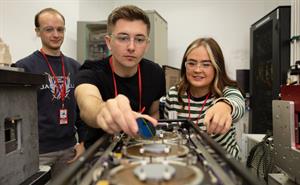
Students using ISIS for experiments.Below are some of the ways that ISIS can contribute to, and partner with, potential CDTs. We would welcome discussions with those putting CDT proposals together on how we can work with you – please contact Martin JonesPhilip King or Sean Langridge​ at ISIS.

A variety of opportunities already exist within ISIS’s normal activities that are relevant to CDTs:

​1. Training opportunities for students:​

  • Two 1-day meetings annually dedicated to students using ISIS, for training, presenting and networking with other students
  • An annual practical neutron training course
  • The bi-annual Oxford Neutron Summer School
  • The bi-annual ISIS Muon Training School
  • Numerous courses and workshops on facility techniques, software and analysis, modelling, etc.
  • The experience that students have when they come to ISIS to run experiments (which includes informal, ‘on-the-job’ training in areas such as neutron scattering or muon spectroscopy, complementary characterisation, cryogenics, data analysis, experiment planning, etc.). Around 600 PhD students come to ISIS to run experiments every year.
  • Opportunities for students to give talks or seminars

This is not an exhaustive list and we welcome discussion of additional possibilities which might be provided through additional CDT resources. For example, we can consider a special day or course for CDT students where usage of ISIS is likely to be high and where the CDT can provide resources to enable this.

​​2. ISIS staff as student co-supervisors.

​3. ISIS staff as members of advisory boards, steering groups, science advisory groups for CDTs

4. ISIS staff members who can give lectures on neutron scattering or muon spectroscopy

5. The ability to apply for co-funded students within a CDT through the annual ISIS facility development studentship call.

For CDTs where ISIS is likely to have a close involvement – where CDT usage of ISIS is likely to be high and there is benefit in a strong ISIS-CDT partnership – ISIS may pre-allocate one or more co-funded studentships. The criteria for this include ISIS being recognised within the CDT as an academic partner; a ​suitable project of mutual benefit, with a suitable ISIS co-supervisor, being identified; the ISIS co-supervisor being offered a visiting position at the partner university.  We would be pleased to discuss these partnerships with potential CDT proposers.​

Provision of beamtime for CDT students

CDTs involving use of ISIS will necessarily require access to ISIS beamtime which is itself a training opportunity for students as described above. Beamtime provision should occur through existing ISIS proposal mechanisms. Proposals involving CDT students will be welcome through the normal (twice per year) ISIS proposal calls. Express access proposals, for small amounts of trial beamtime on some instruments, would also be welcome, as would rapid access proposals for more urgent use of the facility.  CDTs involving industrial partners may wish to explore the ISIS collaborative R&D scheme for industry to gain access.​  For details of ISIS proposal mechanisms please see here.  ISIS provides travel and subsistence support for UK-based students to come to the facility for experiments, and contributions towards the cost of consumables for sample preparation for experiments.​

Supervisors

Students